Thursday, April 23, 2015

Acts 1. In my former book, Theophilus, I wrote about all that Jesus began to do and to teach until the day he was taken up to heaven, after giving instructions through the Holy Spirit to the apostles he had chosen. After his suffering, he presented himself to them and gave many convincing proofs that he was alive. He appeared to them over a period of forty days and spoke about the kingdom of God. On one occasion, while he was eating with them, he gave them this command: “Do not leave Jerusalem, but wait for the gift my Father promised, which you have heard me speak about. ForJohn baptized with water, but in a few days you will be baptized with the Holy Spirit.” 

Then they gathered around him and asked him, “Lord, are you at this time going to restore the kingdom to Israel?” He said to them: “It is not for you to know the times or dates the Father has set by his own authority. But you will receive power when the Holy Spirit comes on you; and you will be my witnesses in Jerusalem, and in all Judea and Samaria, and to the ends of the earth.” 

After he said this, he was taken up before their very eyes, and a cloud hid him from their sight. They were looking intently up into the sky as he was going, when suddenly two men dressed in white stood beside them. “Men of Galilee,” they said, “why do you stand here looking into the sky? This same Jesus, who has been taken from you into heaven, will come back in the same way you have seen him go into heaven.”


So. I signed another contract with the Smyrna Session, marking my second anniversary as Interim Pastor. This will (almost) certainly be the last contract I sign; while three years isn’t really that long for a church to be ‘in transition,’  it is rather long for an Interim Pastor to serve, at least in Presbyterian circles.


Sometimes it's just too easy.

Since this is the Easter Season, I have been thinking a lot about the post-resurrection stories of Jesus. After he was raised from death back to life, Jesus was a busy fellow; turning up in several places to meet with the disciples. The first few of these appearances were mostly for show – for demonstration purposes; in the cemetery, and in the locked upper room, the amazing thing was just that Jesus was there - alive. 


But these appearances quickly develop an agenda: Jesus helping the disciples prepare for what was to come. There were things they needed to know, to understand – so Jesus taught them, interpreting scripture in a radically new way; there were things they needed to hear, and say – and Jesus spoke to them, and demanded from them a response. They needed to start looking for – preparing for - what would come next, so Jesus promised them a new counselor, as he arose out of sight, leaving them staring after him, thinking, what ever shall we do?

That’s right: 
the Risen Christ was an Interim.

I especially like that last image – I imagine the congregation assembled in the parking lot, gazing after my belching rattle can Volvo as is putters off into the sunset…


I may need to get the injection pump checked.
Seriously, I have been thinking a lot about this; my Call and my job, not the ‘Jesus was an Interim’ thing. I have been pondering how my position fits into what my Catholic friends call the Christian Vocation.


One does miss out on some things being Protestant.

We Presbyterians tend to have a pretty high sense of Call, especially when it comes to what we call Teaching Elders. Wused to people like me call Ministers of the Word and Sacrament, before that became too much of a mouthful and we went back to the future with a traditional title. A Teaching Elder, for example, does not have a contract with a church; they instead agree to Terms of Call, which includes not just basic compensation, but much more - it is actually a covenant in which both pastor and congregation promise to care for one another. While Terms of Call may be negotiated by smaller groups within the church, the Call itself is extended to a Teaching Elder by an act of the congregation, and ratified by the Presbytery; as such, it is not easily rescinded. But for us Interim Pastors, the work, and thus the ‘Call’ are not quite the same.


What’s the dif? you might ask. 

Especially if you’ve just arrived from 1919. 
Both preach, Both run meetings, and visit sick people; 
what the heck?

Ah, but it is different - very different. For the Interim, the relationship is not defined by a covenant with the congregation; but rather by a contract with the Session, which outlines specific responsibilities and covers a set period of time. Instead of defining ministry in terms of deepening relationships and expanding programs, the Interim’s task is delineated by a sort of checklist: saying the things the congregation needs to hear; teaching them things they need to learn; encouraging them to do the things they need to do, to prepare for what God has in store for them. These, along with other benchmarks, help the Interim gauge how close the congregation is to that next transition, the one that leads to a new Call.

Of course, one can argue such things come under the heading of ‘God’s Time,’ and I do – often with myself.  And it’s true the process of discernment has led the Smyrna Session to consider new models of ministry, and that takes time, especially if you want to do it right. But the clock is running – I can feel it.


Don’t get me wrong – I’m having a ball.  Worship at Smyrna is just a delight – I have more fun in the pulpit than anyone really should (including probably me); meals and receptions are great; and even the mundane meetings about which we preachers like to complain are mostly fun. And, truth be told, there are some definite perks to being an Interim; I get to be myself, but in the best way;


Thank you.
I get to go with my best stories, reconstruct my best sermons, trot out all my very best examples; I get to answer questions not just honestly, but candidly, without the hesitation that comes along with a vested interest in a long term pastoral relationship; in short, I have the luxury of calling things as I see them, without worrying somebody won’t like it and will then make my life miserable. After all, I’m just a temp; if you don’t like what I’m telling you, you can take comfort in knowing that soon my belching rattle can Volvo will be puttering off into the sunset for the last time.


Don't forget me, Preacher!
  

Truth be told, my checklist is largely complete. After looking hard at themselves, and looking out into the community, these folks are pretty much ready to go. There is restlessness here, in the church, a longing for the kind of relationship with a minister that can only develop over time. 


Just kidding.

It’s getting to be time for the Smyrna to form the kind of open-ended relationship that leads to deep and lasting connections; and that just isn’t in my job description. I don’t know just when, but the days are coming for a new Call here at Smyrna.


Monday, February 23, 2015

I hate snow.

I recognize that may seem to be a precipitous statement (precipitous, HA! because snow=precipitation), but I have my reasons.  Good reasons. Very good reasons.

First, snow is cold. I recognize this is axiomatic, but consider for a moment my feet.

I grow old ... I grow old ... I shall wear the bottoms of my trousers rolled.*
Be glad they're in slippers. Feet are kind of gross.
For as long as I can remember, cold feet have been the salient feature of winter for me - especially in the snow, which seems to be a thoroughly efficient conduction medium.  Once my feet get cold, the beauty of a freshly fallen blanket of white quickly turns to ice. Purple, this little piggy went to the meat locker ice. As someone who grew up refusing to button my jacket ever, for any reason, and who still tends to go without outerwear much of the time, this may seem spurious; but consider this: I ALWAYS wear socks. And shoes. But the truth is, thermal socks are a joke; insulated boots lie. (I will admit I never tried those weird electric sock things because, let’s face it, live wires woven around my person sounds more like a torture method than a winter strategy.)

Really - who wants to attract lightning with their FEET?
No matter what I do, my feet get cold, and I believe I am on firm, temperate ground when I say this:
When your feet are cold, there is no joy in the world.

Then there’s the shoveling. I have a theory: a person’s appreciation for snow is in inverse proportion to the amount they have actually had to shovel - those who love it most (children, rich skiers, my dogs) are the ones who shovel it the least, and vice versa. Some of you might take exception to this, insisting that  you just love shoveling snow, or don’t really mind wrenching your back over and over again, or think frostbite and a nasty Ben Gay addiction is a small price to pay for winter beauty; feel free to peddle your bizarre life observations to whoever will listen, he says with his fingers in his ears while he says LALALALA...

I have said it before and I’ll say it again: I shoveled enough snow in 1977 to last me a lifetime. And then I did it again in 1978. 


To give you a sense of scale, my sister is seven feet tall.
And standing on my shoulders.

Snow in Pittsburgh. Snow in Finleyville. Snow in Leicester. Snow in Linesville. Snow in the Valley. My life has been full of snow - mountains and mountains of snow. I get tired just thinking about it. And my feet are getting cold.

And consider this: snow is a lie. It offers a sort of false reprieve, - a fleeting illusion that things are fine, lovely, even, clean. A story: in one of those dark, snowy high school years, a friend brought me home from a band rehearsal in the family truckster – a Chevelle Malibu Station Wagon.

                                                                                      Photo by Roadsidepictures
Check out the angle of the tailgate – it will become significant in just a second.

After I removed my guitar case from the way back, he went to shut the tailgate, failing to notice how far back the rest of the equipment had shifted.  Down came the tailgate; crash! went the back glass; @#$%! went my friend. The back window was everywhere, except in the back window– mostly on the floor of the car, but quite a lot in the driveway, too, it turned out. I say it turned out because at that moment, I couldn’t tell – all those little pellets of window were nestled snug in the snow that covered everything. It wasn’t until spring (sometime in July, I think), long after my friend had invented some story about those darn Baldwin Borough kids throwing snowballs,  my father asked me, what is all this glass doing all over the front yard? WHAT DID YOU DO???  

And lest you think this sort of snow hiding a multitude of sins thing is somehow a rare occurrence, just come look at our back yard when the big thaw comes.

They may look dead, but trust me, their alimentary canals are open for business.

Which brings me to Lent. Clever transition, I know.

I have always found it intriguing that American Christians use such decidedly rustic, (that is to say pagan) words to describe both the central defining event of the faith, and the period of preparation which precedes it; Easter is derived from the Old English name of a Germanic goddess of the dawn, while Lent is a shortened version of the Old English for Spring (Lencten, reflecting the lengthening of the days...) Within these Old English terms there is, I believe, an instructive lesson in the purpose of what is called in Latin Quadragesima, the forty days, and of the significance of the Paschal celebration of the resurrection.

For many of us, Lent comes around at the low point of the year. The 'fun' of Christmas is long gone, and the worst of winter has settled upon us; it's freezing, and we’re tired of the darkness, of the extra effort required to do the most mundane things. 


Photo by Tobi Mattingly
Getting the paper.

But all at once, we have the opportunity to change our frame of reference. Ash Wednesday reminds us not only of our mortality (which certainly puts my cold feet in perspective), but of God’s amazing love for his frail, broken children.


Remember that thou art dust, and to dust thou shalt return.


Each day in Lent, we are challenged to consider that truth, in all its glory, all its contradictions. Using the disciplines of the church, we can mark the movement from winter to spring with our own journey from sin to salvation, a journey which takes us deep into our own hearts, then back to Jerusalem with the cheering crowds, through the Stations of the Cross with Jesus on the road to Golgotha, to a borrowed tomb with Joseph and the women, and a locked second story room with the disciples, awaiting the dawn of a new day.

Lent starts out in the Bleak Midwinter**, and it is work – hard work, sometimes. But if we do it right, it shatters the illusion that our darkness, our sin, is hidden away; it uncovers the truth, in all its ugliness and beauty, and shows, once and for all, we can clean up the mess, because in Jesus Christ, God says we can – and he’ll even help.

All images are subject to the Creative Commons license.

* from "The Love Song of J. Alfred Prufrock" by T.S. Eliot (1888-1965). 

**A fine poet, Christina Rossetti apparently forgot to check the calendar; Christmas is at the beginning of winter. Barely. Yes, I was a Lit major; get over it.


Thursday, January 22, 2015

Football, Cheating and the Morality of the Fan

I haven’t watched an NFL game this season. 
I may never watch one again.

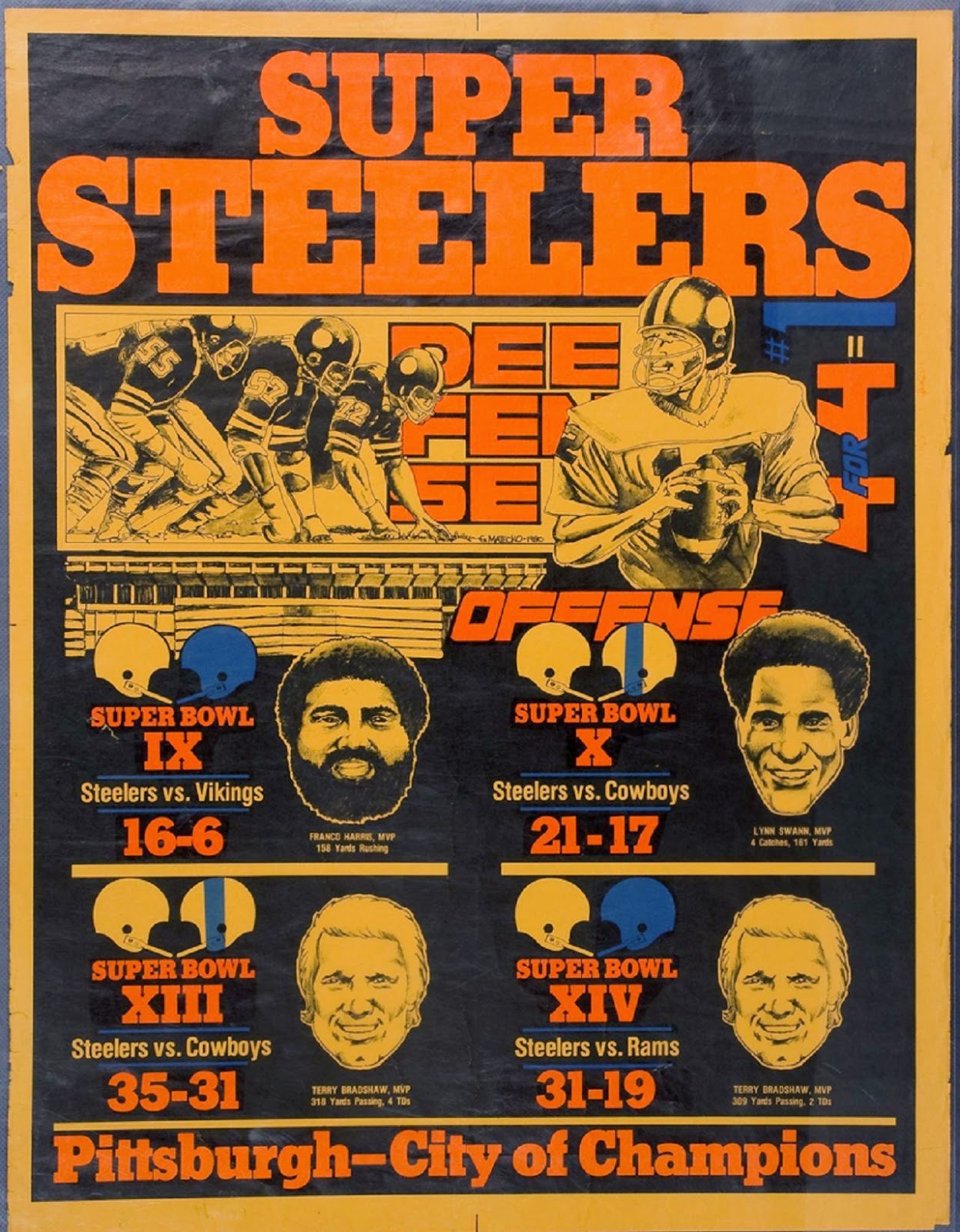
That’s a tough thing to say. I was a football fan for as long as I remember, long before I understood any of the finer points of the game. I grew up with football. When I was very small, back in the dark days of Steeler history, my family shared a row house with their punter, Frank Lambert.* 
I actually have this card. Cool, huh?

I remember the antics of Joe Namath in the late sixties, but my first clear memory of a football game was watching Johnny Unitas and the Colts edge out the Dallas Cowboys 16-13 in Super Bowl V, a game also referred to as the Stupor Bowl. I rooted for Baltimore – after all, Unitas was a Mt. Washington boy, just like my grandfather.
It was perhaps not the most auspicious game with which to start.
A few years later, my dad took me to see the University of Louisville play when he was a graduate student there.

Louisville coach Lee Corso, before he went completely around the bend
and started wearing bizarre costumes on ESPN.
My playing career was mercifully brief: one seemingly endless season as center on a Pop Warner team at the St. Matthews YMCA. I was a preternaturally tall, painfully thin klutz, who was routinely submarined by any and all nose guards who lined up against me. I quickly tired of the repetitive drill, the yelling, the strict regimentation and, in particular, the divots of turf I had to pick out of my face mask with depressing regularity. But I learned some things about the game, and just in time; when we moved back to Pittsburgh, the Steelers were poised to become a citywide obsession, the preeminent team of the 1970s.

I had a Terrible Towel®, too. 
At Bethel Park High School, I played a little basketball, but was really a band geek. The marching band, though, was an integral part of every football game, so I was a Blackhawk.
 
Orange and black, attack - ATTACK!

In my time, I have rooted for Pitt over Penn State, Texas A&M over Texas, Fort Defiance over Harrisonburg, Virginia Tech over Virginia. In turn, I have hated Cleveland. And Dallas. And Oakland. And Houston. And Baltimore. And New England. And refs, who made bad calls against any of 'my' teams.

For some reason, the Vikings only aroused a vague sense of pity.
I loved football, especially football on television, with that evolving combination of commentary, analysis and personality which not only made sense of the action, but drew you into the experience. After more than 30 years, I still remember the disappointment of my first (and to date, only) live, in person Steeler game – the cold, the bad sight lines, and what I can only describe as the lack of a coherent narrative. 

Television, and the media in general, had provided for me a particular narrative: the tale of the kindly owner who paid $2500 for a franchise in 1933, and worked hard to establish the struggling NFL; the decades of humiliation and mediocrity until the trinity of Noll, Green and Bradshaw arrived to transform the Smoky City into the City of Champions; the narrative of a benevolent paterfamilias who embodied all the best of the league he loved, and passed that legacy on to his family, a sacred trust.

Amen. 
Of course as part of that narrative, I believed that Tom Landry was a soulless technocrat, ruining the game with his formulas and charts; Bum Phillips was an ignorant blowhard, and that John Madden was a big old dirty cheat; while Chuck Noll walked on water, even when the Allegheny River wasn’t frozen. 

Sorry, guys.

It turns out, Landry was the consummate gentleman, Bum, the quintessential player’s coach, Madden an entertaining, down to earth expert on the game; and Chuck Noll was a complicated and mercurial man.

Likewise, I grew up believing Joe Green and Jack Lambert were tough competitors, but the Jack Tatum and Conrad Dobler were thugs, who ought to be locked up.

Of course, this didn’t help.
I realize now that being a fan, accepting the narrative, as it were, seems to lead to an awkward level of...well, moral flexibility, at least for me. To wit: 

I was indignant about the plea bargain offered 
to Ravens linebacker and alleged murderer Ray Lewis in 2000.


Yet somehow I managed to compartmentalize 
the various accusations of Rape and sexual assault 
against Pittsburgh quarterback Ben Roethlisberger.
I mean, really; I am the father of two daughters.
I had no problem believing this could be an accident: 


While at the same time believing the dastardly Bill Belichick 
had cheated by spying on his opponents’ signals.
Actual incriminating photo.
I grew up understanding that football was a tough sport for tough men; men who do whatever it takes to win; men would rub some dirt on it and get back into the trenches; men who were used to pain – inflicting it, playing through it; reveling in it. That’s what makes it so good, I told myself. 

I never thought those men were killing themselves to entertain me. 

And I certainly didn't think the NFL would put profit above literally everything else, including the well being of everyone who may have a relationship with an NFL player. 

But then my eyes began to open, just a bit, and my mind began to change; I began to see another narrative. On October 9, 2015, The documentary League of Denial, the NFL’s Concussion Crisis was broadcast as part of the PBS series Frontline. 

Based on a book by ESPN reporters Mark Fainaru-Wada and Steve Fainaru, League of Denial examines the long-term effects of traumatic head injury on NFL players, and the league's response. Exhibit number one is the life and death of Hall of Fame center Mike Webster, whose sixteen year career with the Steelers left him with Chronic Traumatic Encephalopathy (CTE), a degenerative neurological disease. CTE caused amnesia, Dementia and Depression, which exacerbated the crippling bone and muscle pain of the NFL veteran. Webster died homeless in 2002 at age fifty, even as friends, family and former teammates sought to help him. The Fainaru brothers make a persuasive argument that for almost thirty years, the NFL consistently denied there was any connection between head trauma and neurological damage, even when confronted with the evidence.

Rest in Peace, Iron Mike.

And then in the spring of 2014, it was reported that Ray Rice, running back for the Baltimore Ravens had assaulted his fiancée, Janay Palmer in an Atlantic City hotel, knocking her out cold and dragging her inert body out of an elevator.

I had a picture here, but no.

Although charged with Aggravated Assault, Rice would end up married to his victim, in a Pretrial Intervention Program, and an unrestricted Free Agent as of December 1. Finally, in September of last year, Minnesota Vikings Running Back Adrian Peterson was indicted for Reckless or Negligent Injury to a Child, after it was found he had beaten his four year old son with a tree branch. This time, the inconsistency of the league's responses was on public display. A new narrative emerged:


What finally dawned on me was this: despite years of hard work, and millions of dollars spent to craft an image as a noble endeavor, a sport which represents the finest qualities of America the Beautiful, in reality The National Football League is a sordid business, in which greed has trumped both short and long term concerns over the health of its employees, even though they are its only draw; a business that is only too happy to cultivate women and exploit children as consumers, even what it ignores them as potential victims of their own employees, because they are its only draw; a business which is more concerned with how its employees look to their advertisers than how they behave to those closest to them.

And so I stopped watching.

As I write this, the narrative spectacle of the 2015 Super Bowl has been tarnished by reports that 11 of the 12 footballs prepared and used by the Patriots in their playoff rout of the Indianapolis Colts were under inflated, thus making them easier to both throw and catch. 
Under inflated? Are you sure?
This sounds a lot like cheating, being as there is an actual rule specifying how much air each ball should contain. I have been asked for my ‘take’ on this, the latest Patriot cheating scandal so here it is.

Does Bill Belichick cheat? Yeah, probably - just look at the man:

That’s him on the left. I think.
But so what? 

The National Football League has bigger problems.

Like the fact that Ann and I are going to see a movie on Super Bowl Sunday.


*Dr. Franklin T. Lambert. Punter, Pittsburgh Steelers, 1965-1966 seasons; Professor of History at Purdue University; author and fascinating fellow. You can read about him here: https://pittsburghsportsdailybulletin.wordpress.com/2012/02/29/frank-lambert-steelers-punter-1965-1966/)